


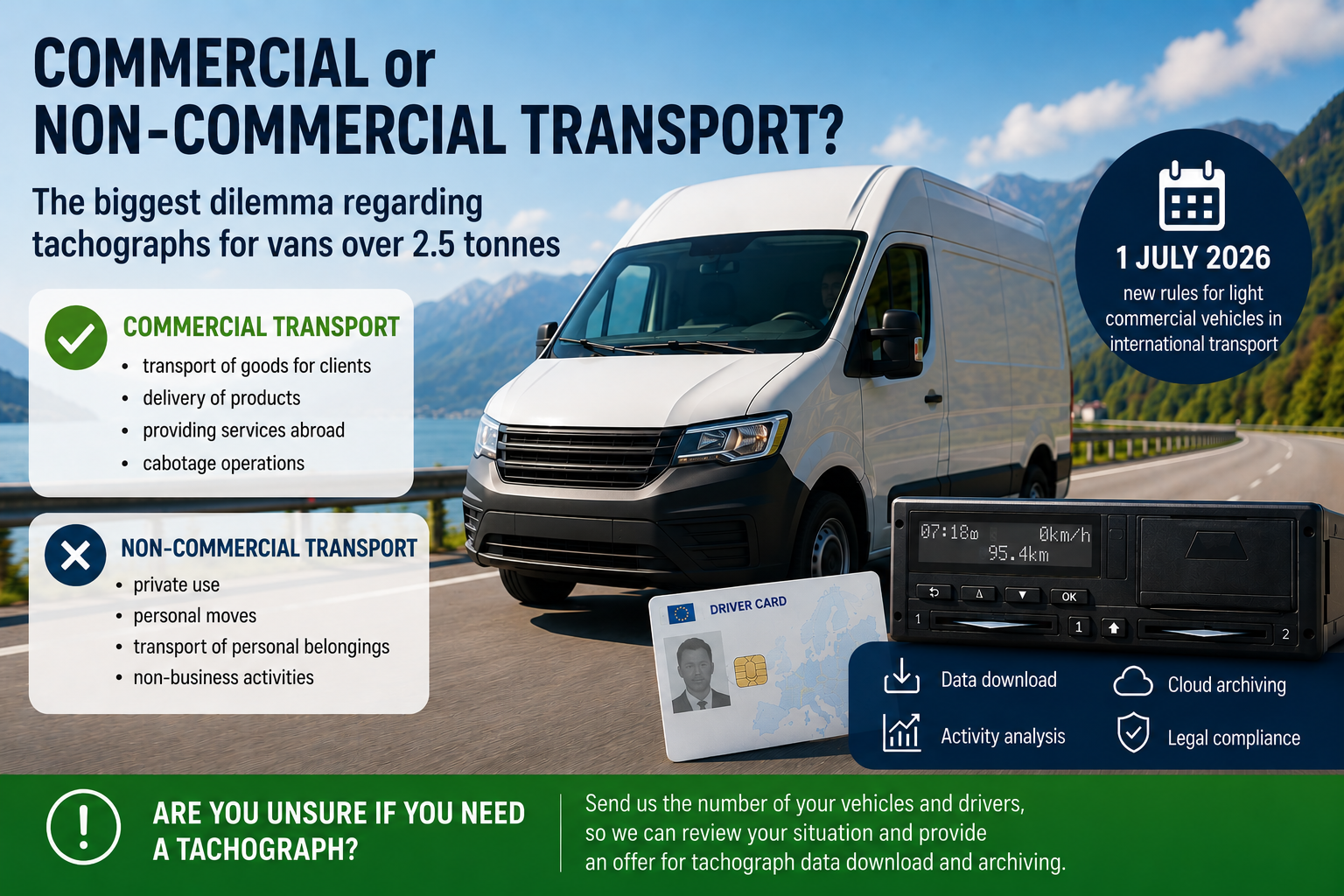
Does your van need a tachograph?
From 1 July 2026, new tachograph rules will apply to many businesses across the European Union. The biggest questions come from owners of vans and light commercial vehicles with a maximum permissible mass exceeding 2.5 tonnes that are used for international transport within the EU.
Many companies are asking:
- Do I need a tachograph if I transport my own goods?
- Does the obligation apply only to transport companies?
- What is considered commercial transport?
- Are there exemptions for tradespeople and service companies?
- Do I need a driver card?
- How are tachograph data downloaded and archived?
The answer is not always straightforward because the type of vehicle and the way a company uses it both play an important role.
Below, we explain the most common real-world examples.
What is commercial transport?
Many businesses mistakenly believe that commercial transport only applies to professional haulage companies.
This is not correct.
When determining whether a tachograph is required, the key question is:
Is the vehicle being used as part of a business activity?
If the answer is yes, authorities may classify the transport as commercial, even if the company is not registered as a transport operator.
Examples of commercial transport
- Delivering products to customers in another country
- Transporting goods between company branches or warehouses
- Providing services to customers abroad
- Transporting materials required to perform a paid service
- Carrying goods on behalf of another company
If the transport is connected with generating revenue or carrying out an economic activity, it will generally be considered commercial transport.
What is non-commercial transport?
Non-commercial transport is not connected to a business activity or income generation.
Examples
- Private use of a vehicle
- Personal relocation
- Transport of personal belongings
- Voluntary or charitable activities without payment
- Private sports and leisure activities
In these situations, the EU Mobility Package tachograph rules generally do not apply.
Why is the 2.5-tonne threshold so important?
The EU Mobility Package extended driving and rest time rules to certain light commercial vehicles.
From 1 July 2026, many vehicles and vehicle combinations with a maximum permissible mass exceeding 2.5 tonnes must be equipped with a second-generation smart tachograph (Smart Tachograph G2V2) when used for international commercial goods transport.
For many businesses, this will be the first time dealing with:
- Driver cards
- Company cards
- Digital tachographs
- Tachograph data downloads
- Data archiving requirements
- Working time records
- Driving and rest time compliance
10 Practical examples
1. A furniture manufacturer delivers products to another country
A company manufactures furniture and delivers it to customers in another EU country using its own van.
This is a cross-border business activity.
In many cases, such vehicles may fall under the new rules from 1 July 2026.
2. An online store delivers orders across borders
The company uses its own van to deliver orders to customers in another EU Member State.
Because this activity involves international commercial transport, companies should assess whether the new rules apply.
3. A construction company transports materials to a building site abroad
The company uses a van to transport materials to a construction site where paid services are being carried out.
This is one of the most common scenarios among tradespeople and contractors.
Companies should always check whether any exemptions apply.
4. A window installer delivers windows for installation abroad
The transported goods are part of a service sold to a customer.
Because the activity generates revenue, tachograph regulations may apply.
5. An HVAC technician carries equipment to a customer in another country
The company is not providing transport services for others, but it is performing a paid service.
Companies should assess each case individually.
6. A company transports goods for another business
This is a classic example of commercial transport.
Such operations will generally fall within the scope of tachograph regulations.
7. An electrician carries their own tools
If a driver transports tools required for their own work, specific exemptions may apply in certain circumstances.
Companies should evaluate each case individually.
8. A charity transports humanitarian aid
If the transport has no commercial purpose and is not linked to generating revenue, it is generally not considered commercial transport.
9. A company moves goods between warehouses in different countries
Transporting company-owned goods between EU Member States is generally considered a cross-border economic activity.
10. A van is used only domestically
If the vehicle operates exclusively within one country and does not perform international transport, the new requirement from 1 July 2026 will generally not apply.
What is cabotage?
Cabotage refers to domestic transport operations carried out within a country by a transport operator established in another country.
Example
- A company delivers goods from one EU country to another.
- It then picks up a new load within the destination country.
- The load is transported to another location within the same country.
Because both loading and unloading take place within the same country, authorities classify this as a cabotage operation.
Special rules apply to cabotage transport.
What obligations will businesses face?
If a vehicle falls under the new regulations, the company may need to ensure:
- Installation of a Smart Tachograph G2V2
- Company card registration
- Driver cards for drivers
- Regular data downloads
- Legal data archiving
- Driver training
- Driving and rest time records
- Compliance with EU transport legislation
What data does a digital tachograph record?
A smart tachograph records:
- Driving times
- Breaks
- Rest periods
- Working time
- Vehicle speed
- Distance travelled
- Border crossings
- Vehicle information
- Driver information
Modern G2V2 tachographs automatically record border crossings and other compliance-related events.
What are the consequences of non-compliance?
Common violations include:
- Missing tachograph
- Late data downloads
- Improper data archiving
- Missing driver card
- Incorrect tachograph use
- Failure to calibrate the tachograph
Penalties vary between countries but can be substantial.
How are tachograph data downloaded and archived?
Companies must regularly download:
- Driver card data at least every 28 days
- Vehicle unit (tachograph) data at least every 90 days
The data must be securely stored and made available to enforcement authorities when requested.
To simplify compliance, businesses can automate the entire process using Tacho4u.
A simple solution for tachograph data download, analysis and archiving
If your company already operates vehicles with tachographs or expects to be affected by the new rules from 1 July 2026, the entire compliance process can be automated.
With TachoSafe Connect, you can:
- Automatically download tachograph and driver card data
- Legally archive data in the cloud
- Monitor download deadlines
- Analyse driver and vehicle activity
- Review driving and rest time infringements
- Access your data anytime and anywhere
This eliminates the need for regular workshop visits solely for tachograph data downloads.
Not sure whether your vehicle requires a tachograph?
Because the legislation includes numerous exceptions and special cases, it is often impossible to provide a definitive answer without understanding the specific circumstances.
Send us an inquiry at info@tacho4u.com and include:
- A description of your business activity
- Number of vehicles
- Number of drivers
- Whether you perform international transport
- Whether the transport is carried out for commercial purposes
We will provide an initial assessment of your situation and prepare a proposal for compliant tachograph data download, analysis and archiving.
Frequently Asked Questions (FAQ)
Will every van over 2.5 tonnes need a tachograph?
No. The purpose of the transport, the type of activity and any applicable exemptions are all important factors.
Do I need a tachograph if I deliver my own products abroad?
Possibly. Such cases often constitute a cross-border economic activity and should be assessed individually.
What is a driver card?
A driver card is a personal smart card used by drivers. It stores driving times, rest periods and other driver activities.
How often must data be downloaded?
Driver card data must be downloaded at least every 28 days, while tachograph data must be downloaded at least every 90 days.
What is a Smart Tachograph G2V2?
It is the latest generation of digital tachographs, featuring automatic border crossing registration and enhanced compliance monitoring capabilities.
Legal Sources and Legislation
Regulation (EC) No. 561/2006
Sets out the rules on driving times, breaks and rest periods for drivers engaged in road transport.
Regulation (EU) No. 165/2014
Establishes the requirements for tachographs used in road transport, including their use, installation, inspection and data storage.
Commission Implementing Regulation (EU) 2016/799
Defines the technical requirements for digital and smart tachographs, including second-generation smart tachographs (G2V2).
Regulation (EU) 2020/1054 (Mobility Package I)
Introduces amendments to driving and rest time rules and extends the scope of tachograph requirements to additional vehicle categories, including certain light commercial vehicles engaged in international transport.
European Commission – Tachographs in Road Transport
Provides official guidance on tachograph obligations, including the new requirements for vehicles over 2.5 tonnes that will apply from 1 July 2026.
European Labour Authority (ELA) – Light Commercial Vehicles from 2.5 to 3.5 Tonnes
Provides guidance on the application of tachograph requirements to international goods transport and cabotage operations from 1 July 2026.
Disclaimer
This article is based on current European Union legislation and publicly available information published by competent authorities. As numerous exemptions and special circumstances may apply, each case should be assessed individually.
For official legal interpretation, we recommend consulting the relevant authority or a qualified transport law specialist.
Liability Disclaimer
The content of this article is provided for informational purposes only and does not constitute legal advice. While every effort has been made to ensure accuracy and currency, we accept no liability for any errors, omissions, or consequences arising from the use of the information contained herein. For binding interpretations and decisions, please consult the relevant authorities or legal professionals.