


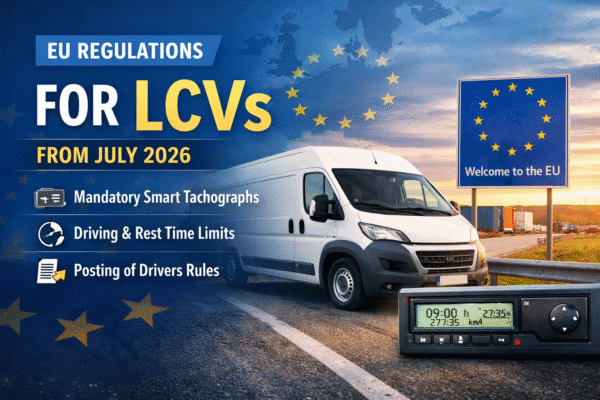
From 1 July 2026, new EU transport regulations for light commercial vehicles (LCVs) will come into force. These changes will significantly impact companies engaged in international transport and cabotage operations using vehicles between 2.5 and 3.5 tonnes.
For many operators, this will be the first time they must comply with EU driving time rules, rest period regulations, posting of drivers requirements, and mandatory smart tachograph installation.
In this guide, we explain what is changing, who is affected, and how to prepare for compliance.
What Changes in July 2026 for Light Commercial Vehicles?
Starting 1 July 2026, light commercial vehicles used in:
-
International transport of goods
-
Cabotage operations within another EU Member State
will fall under EU road transport legislation.
The new rules apply to vehicles with a maximum permissible mass exceeding 2.5 tonnes and up to 3.5 tonnes, including trailers or semi-trailers.
Until now, many LCV operators were not subject to full EU driving and tachograph regulations. This will change completely.
Key obligations from July 2026:
-
Compliance with EU driving time limits
-
Respect of mandatory breaks and rest periods
-
Application of posting of drivers rules
-
Installation of Smart Tachograph Version 2
-
Proper documentation and roadside inspection readiness
Which Vehicles and Drivers Are Affected?
The rules apply to:
-
Light commercial vehicles between 2.5t and 3.5t
-
Vehicles used for cross-border transport
-
Drivers employed by EU-established transport companies
The driver’s nationality is irrelevant. What matters is whether the transport operation involves cross-border or cabotage activity within the EU.
Purely domestic transport may remain outside scope in certain cases, but any international activity automatically triggers compliance obligations.
EU Driving Time Rules for LCVs (From 2026)
One of the most important changes concerns maximum driving times.
From July 2026, LCV drivers must respect:
-
Maximum daily driving time: 9 hours (extendable to 10 hours twice per week)
-
Maximum weekly driving time: 56 hours
-
Maximum bi-weekly driving time: 90 hours over two consecutive weeks
These limits aim to:
-
Reduce driver fatigue
-
Improve road safety
-
Ensure fair competition
-
Prevent excessive working hours
Fleet managers will need to review scheduling systems and delivery planning to ensure compliance.
Mandatory Breaks and Rest Periods
LCV drivers will also be subject to strict EU rest regulations.
Break requirements:
After 4.5 hours of driving, a driver must take a 45-minute break.
This break can be split into:
-
15 minutes + 30 minutes
Daily rest:
-
Minimum 11 uninterrupted hours
-
Can be split into 3 hours + 9 hours under specific conditions
Weekly rest:
-
Minimum 45 uninterrupted hours
-
Reduced rest allowed in limited cases (with compensation)
-
Regular 45-hour weekly rest cannot be taken in the vehicle
Employers are responsible for covering accommodation costs when required.
Posting of Drivers: When Does It Apply?
The posting of drivers rules apply when a driver is sent to work temporarily in another EU Member State.
Posting typically applies in:
-
Cabotage operations
-
Cross-trade operations
Posting generally does NOT apply in:
-
Bilateral transport
-
Simple transit without loading/unloading
If posting rules apply, drivers may be entitled to:
-
Host country minimum wage
-
Local working conditions
-
Applicable allowances
Drivers must carry documentation during roadside inspections, including:
-
Transport documents
-
Tachograph records
-
Proof of posting declaration submission
Failure to comply can result in significant fines.
Smart Tachograph Version 2 Becomes Mandatory
From 1 July 2026, affected LCVs must be equipped with a second-generation smart tachograph (Smart Tachograph V2).
This device automatically records:
-
Driving time
-
Breaks and rest periods
-
Border crossings
-
Driver activity
For many LCV operators, this will be the first mandatory use of tachograph equipment.
However, installation alone is not enough. Companies must ensure:
-
Regular tachograph data downloads
-
Secure digital storage
-
Ongoing compliance analysis
-
Proper driver training
Without a structured compliance system, risks increase significantly.
How to Prepare for the 2026 EU LCV Regulations
Preparation should begin well before July 2026.
Recommended steps:
-
Identify vehicles exceeding 2.5 tonnes used internationally
-
Plan smart tachograph installation
-
Update internal scheduling processes
-
Train drivers on EU driving and rest rules
-
Implement a tachograph data management system
-
Ensure posting of drivers procedures are clear
Early preparation reduces operational disruption and prevents penalties.
TachoSafe: Compliance Solutions for LCV Fleets
As tachograph obligations expand to light commercial vehicles, having a reliable compliance system becomes essential.
TachoSafe Connect enables secure and remote download of tachograph and driver card data.
TachoSafe WEB Pro provides advanced compliance monitoring, risk analysis, and complete digital record management.
With the right hardware and software combination, fleet managers can move from reactive problem-solving to proactive compliance control.
For companies entering tachograph compliance for the first time, choosing the right system will be critical.
Frequently Asked Questions (FAQ)
Do all 3.5-tonne vehicles need a tachograph from July 2026?
Only those used for international transport or cabotage operations exceeding 2.5 tonnes fall under the new rules.
Do domestic LCV operations fall under the new EU rules?
Purely domestic transport may remain outside scope, but any cross-border activity triggers EU compliance.
When exactly do the new rules apply?
The regulations apply from 1 July 2026.
More information you can find on www.tacho4u.com.